
Tuesday, April 28, 2026; approx. 4:00 p.m. to 2:00 a.m.

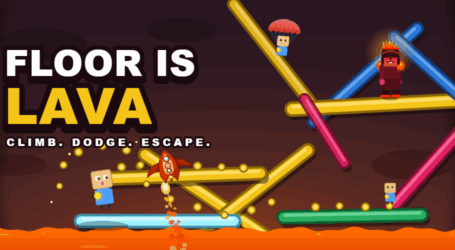
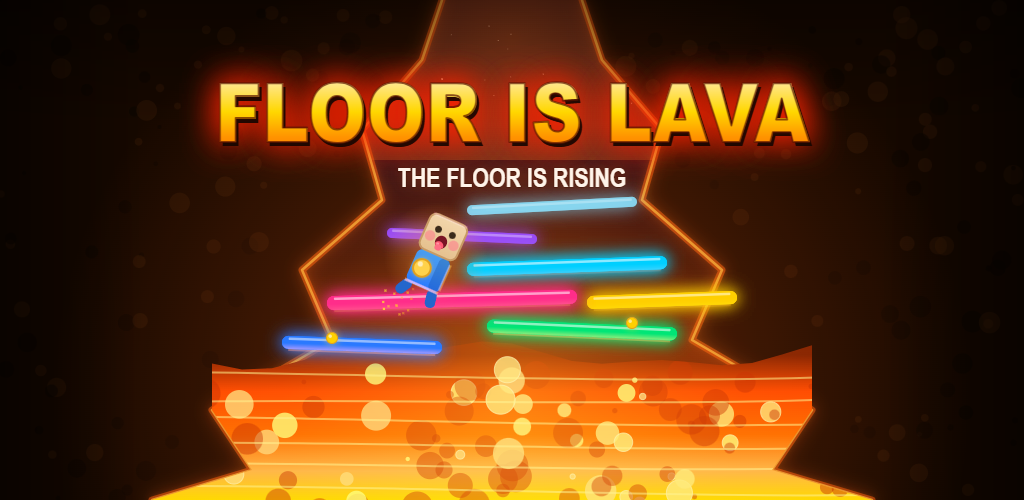
Get Floor Is Lava on Google Play
Lance’s idea
The afternoon started with paper. Lance and I had been building his cardboard game controller: cutting tape into shapes, folding a rectangle into a diamond so it would spin properly. He kept asking, “When are we going to make the lava game?” while I tried to hold the line between his hour and my own work.
We took a break to look at two of our older projects together. I showed him my Retro Racer game, updated with new gameplay, and he threw out ideas on the spot; coins to collect. Then we opened his old Planet Jumper game, the one with the spinning globe, and found a glaring bug: holding the button to eat a spike killed you instead of letting you eat it. I told him we’d probably be able to fix that with the new version of AI.
But Lance had a new idea he wanted more than anything else that night; a lava game. He talked it out loud into my phone so I could feed it to AI later:
“It is easier if you speak it out and I tell AI to write it out for me later.”
Floor Is Lava: game instructions, as told by Lance
Lance recorded the rules himself. This is, essentially, the original design document for Floor Is Lava:
“This game is called Floor Is Lava. You have to press A or the Space button to jump. There are lots of platforms. Some of them are red, some of them are blue, some of them are yellow.
There is a 10% chance that you can get a green platform to spawn, and when you land on a green platform, you get 20 coins, and there’s a coin counter. The reason you have coins is because there is a shop. What you can buy inside the shop is a Jump Boost, so you can jump and skip one or two platforms, and the Jump Boost costs 20 coins.
There is a 5% chance of a purple platform spawning, and the purple platform means danger. There’s a trick to get around it: you have to jump and avoid the purple platform by jumping and not moving onto the platform… Or you can go to the shop and skip one or two platforms.
There’s also a third thing in the shop. The third thing in the shop costs 100 coins, and the 100 coin thing is a book. You can get a book for 100 coins so your head can grow big, and when your head’s big, you can imagine things. So you can bring a platform down and then bring the platform up… You only have five seconds to get onto a platform at the beginning.
When you go above 100 platforms, it goes to the next level. Every 100 platforms equals the next level, and the levels go up by one and the lava rises by one platform… It goes up very slowly; one pixel per 0.1 seconds. The End.”
Almost every mechanic that shipped in the final game: coloured platforms, the coin shop, the “book” power-up, level-ups every 100 platforms, the slowly rising lava; was set out in that first recording.
Game Rules Log: April 28, 2026 (Lance’s original design)
- Press A or Space to jump between platforms
- Platforms come in red, blue and yellow
- 10% chance of a green platform: landing on one gives 20 coins
- Shop: Jump Boost costs 20 coins, skips 1-2 platforms
- 5% chance of a purple platform: touching it is dangerous; jump over or skip it from the shop
- Shop: Book costs 100 coins; lets you pull the platform above you down, then back up
- Only 5 seconds to land on a platform at the very start
- Every 100 platforms climbed = next level; lava rises 1 platform per level, very slowly (1 pixel per 0.1s)
Building it: audio to game
By 5:00 p.m. I’d gotten a bit of time to myself while Lance got distracted by SpongeBob, and used it to work on Retro Racer. Then at 8:10 p.m., with the Retro Racer course editor working and a pit stop added, I turned to Lance’s idea properly.
I took the audio of him talking out the game concept, ran it through Otter.ai, then fed it into Claude AI. I called Lance in from his room: “Come on. I’m going to build Floor is Lava. Help me.”
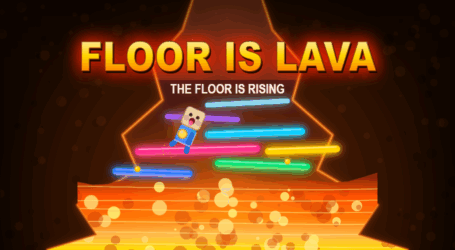
“So, Floor is Lava is basically a vertical platform game. You start on a platform with lava underneath you, and your little player, which is facing you, jumps up to the next platform, then the next platform. The platforms are about a third of the width of the screen. Every time you jump up a platform, you get higher and higher, and the lava is slowly filling up.”
I also recorded a couple of Suno songs for the game that night, both titled “Floor Is Lava.”
First playable, and the parachute
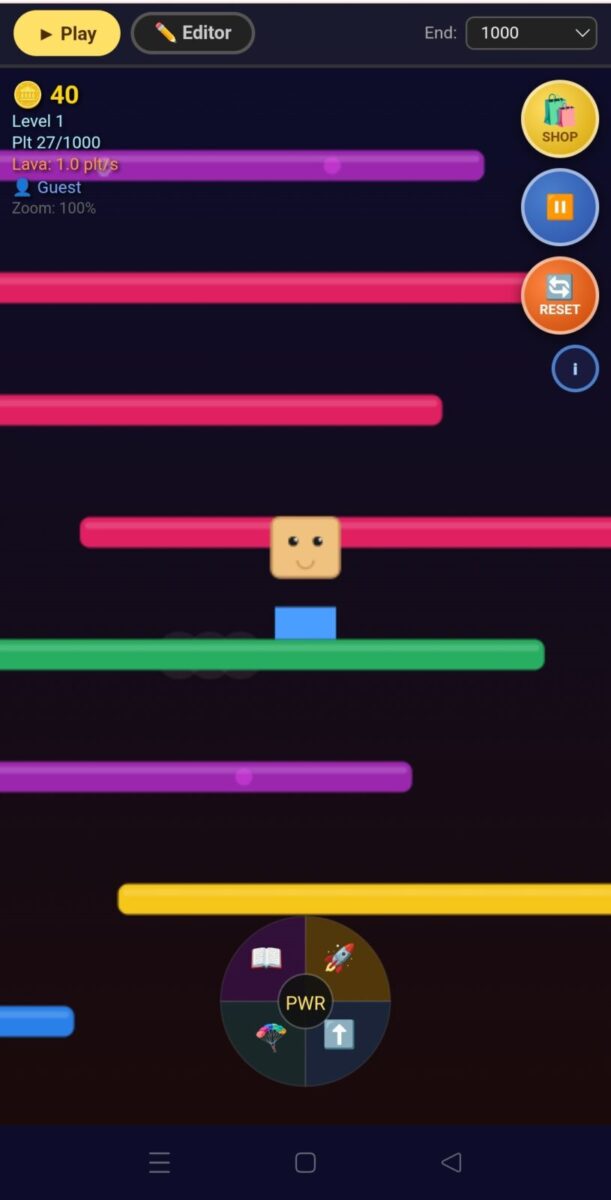
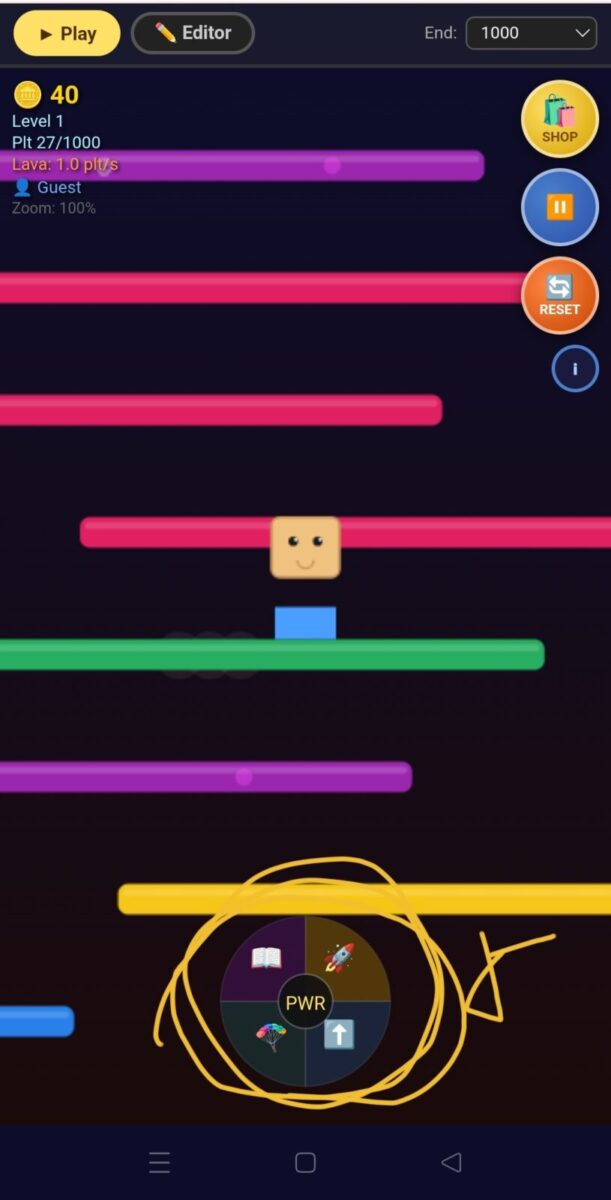
By around 9:50 p.m. it was already fun and “somewhat addictive,” and I’d added the parachute power-up. Once Lance was asleep at 11:10 p.m., I kept going; fixing bugs he’d found when we tested it together on mobile.
Through the evening the version numbers climbed fast, with the level editor gaining a “pattern” tool (place a repeatable strip of platforms with one tap), a gap/reserved-row system with a red hatched overlay, a “move” button for repositioning placed blocks, and a saved-pattern tray at the bottom of the editor showing your packs as thumbnails. Background music was wired in for the menu, Climber mode, and Frogger/Versus modes. Claude also generated a full constants “cheat sheet,” grouped by physics, lava, shop, bots, UI, editor, tips, world and platform, with a live search bar: so I wouldn’t have to go digging through the code for a number again.
Photos from today
Read what happens next in the dev diary: the next entry.

Diary Of A Mad Chaos is a daily diary written from March 1996 until today, of which individual books and book series have been created, namely “The Lost Years” an exploration of young, entwined love, the “Wubao In China (猎艳奇缘)” book series which provides an extensive comparative analysis of the cultural differences between Eastern and Western societies, and the book titled “Foreigner (华人)” an exploration of race relations in Australia.